Margot and I took a Rossiya Russian Airline flight from
Stockholm to St. Petersburg on Wednesday, September 12th. The flight
experience was a little different from those I had experienced in America and
the rest of Europe so far. It felt very similar to what the flight experience
would have been like in the 90’s. Even though the flight was only an hour long,
we got meals, the outfits of the flight attendants made me feel like I was
flying with Pan Am, and when we landed in Petersburg, the plane stopped in the
middle of the runway where we all exited and were taxied into the airport by a
bus. Once we got into the airport, we went through immigration, which took like
three minutes. It seemed crazy that we spent weeks working on and waiting for
our Russian visas in America just so the immigration lady could look at it for
twenty seconds, but I’m glad that the experience was so easy and smooth. Stepping
out the door of the airport, I couldn’t believe it: I was in Russia!
From
the airport, we took a bus into town, which took about thirty minutes. The bus
ride itself was a cool new experience for me; I got to see a Police Officer get
a free ride, discovered that for some backwards reason you pay for your bus
ride when you get to your destination instead of when you get on the bus, and
learned proper public transportation etiquette. Rule #1: If any women older than like thirty gets on
the bus/metro, then you must give up your seat for them. Rule #2: Always take
your backpack off because Russians really really hate it when your back pack is
in their face. Rule #3: Do not put your foot up on any of the seats because
that’s incredibly disrespectful (although not showering for ten days before
getting on the bus/metro is acceptable and encouraged). And finally the most
important rule, Rule #4: Never never EVER smile at anyone on the bus/metro.
There’s a saying in Russia that goes something like, “A person smiling for no
reason is the first sign of insanity.” In essence, they simply don’t smile
around anyone except their close friends and family, it’s odd.
After
our bus ride, we took the metro to our hostel. Well, actually we took the metro
to an old building that was undergoing major construction and realized that we
were definitely not at the right place. Still wearing our jackets from the cool
morning, we walked to a nearby coffee shop in the 75 degree heat with our huge
backpacks on and being the dumbasses that we are, ordered some hot tea, just to
make sure that our body temperature didn’t get below 105 degrees. We did
discover our mistake with the hostel directions however, and set out on the
metro again to give hostel location number two a try. Upon arriving at the
second building, we were still having trouble locating the hostel though. We
ended up asking for directions from this lady who was all dressed up as a war
general on the street corner in order to advertise for a restaurant. She ended
up being the nicest lady in the world, leaving her post and walking us all
around for fifteen minutes until she finally discovered the right building for
our hostel. After thanking her, we shoved the building’s huge wooden door open
to reveal a very skeptical front hallway. It was so dark inside you could
barely see the trash and cigarette butts piled on the 1970’s marble staircase
at the other end of the hall. After taking in a good whiff of asbestos, I
decided not to pass any judgment until we’d seen the actual hostel and started
the long march up seven flights of stairs to Hostel MIR on the top floor of the
building. After passing several floors of huge steel doors with bolt locks that
made me feel like I was in the old meat factory from the Texas Chainsaw
Massacre, my skepticism had not subsided. Fortunately, when we opened the door
to MIR, I was pleasantly surprised to find a beautiful, normal looking hostel
situated inside. The workers were overly friendly, as were the patrons and I would
definitely recommend the hostel for future St. Petersburg visitors. Not only
was it a great hostel but it was also in an incredible location, right on the
main road in St. Petersburg, Nevsky Prospect. Church of our Savior on Spilled
Blood was two blocks away, the Kazan Church was three blocks away, the Winter
Palace/Hermitage was a block away, and St. Isaac’s Cathedral was a five minute
walk away.

After
getting settled in the hostel, we took the metro to Ploshad Vosstaniya
(Uprising Square). In the middle of the square is the Hero City Obelisk which
was given to Leningrad after the Great Patriotic War, known to us as WWII. Why
they feel the need to create their own name for wars I have no idea, what they
call the Patriotic War was the Napoleanic War to the rest of the world. Anyways,
after WWII, five cities in the Soviet Union were given the status of ‘hero
city’ due to the extreme military hardship and suffering they had endured
during the war. The four cities were Leningrad, Stalingrad, Sevastopl, Kiev and
Odessa, with Leningrad being renamed St. Petersburg after the fall of the
Soviet Union. After checking out the monument, we walked down the street to the
huge shopping mall so that Margot could get a new leather jacket, since the
zipper to her original leather jacket had broken back in Copenhagen and she
didn’t want to stick out among the Russians. Because Russians dress fancy all
of the time! Finding a woman who is not wearing heels is impossible, finding
one without a leather jacket is unheard of, and finding one that’s not
downright gorgeous is simply a lost cause. I may have over-exaggerated just a
little bit, but there is definitely an abundance of very attractive women in
Russia, half of which is probably because they all try so hard to look good.
One explanation, given by Margot’s host mom, Marina, from Margot’s semester in
St. Petersburg last fall, is that during the Cold War Russia was so completely
cut off from the West that they didn’t have the opportunity to buy the fancy
clothes and make-up that we had, but knowing of its existence, assumed that
everyone in the West was using it and therefore looked beautiful. So when the
Soviet era ended, they took full advantage of this opportunity to finally buy
the products popular in the west only to discover that they weren’t used in
such abundance as they had originally thought. So now the Russian culture is to
get all dressed up and look pretty, even if you’re just going out to pick up
the paper, while us Americans shuffle out the door in hello kitty slippers and
a wife beater to grab the paper.
After
buying Margot’s jacket we went to this Georgian restaurant called Café
Khachapuri to get a traditional Georgian meal. After receiving our khachapuri, which
is this delicious bread with cheese baked into it, Margot ordered us some tarkhun,
which is the Georgian equivalent of soda pop that happens to be bright neon
green. For dinner Margot had blackberry chicken and I had a lamb garlic stew
and it was really damn good.

After dinner we went down to the magnificent
metro stop to catch the train back to our hostel. Russian metro stops are the
most elaborately decorated metro stations I have ever seen in my entire life: several
times I found myself confused as to whether I was in a metro stop or in
Stalin’s Ballroom. Beautiful sculptors and engravings are everywhere, huge
chandeliers hang from the ceilings, and all of the walls and floors are made of
marble. It’s obvious to tell that everything is from the soviet era, not
excluding the metro trains, which typical to the Soviet Russia attitude, close their
doors with a force strong enough to decapitate anyone running late to catch
their train. I honestly believe that anyone who visits Russia and doesn’t
experience the metro system misses a very interesting piece of the country. I
would seriously consider riding the metro around all day and simply admiring
all of the different stops, they could each be put inside a museum and I would
pay good money to go and see them.
Fortunately, I went to Russia with Margot and thus navigated the metro
system with ease, simply following my travel buddy wherever she went.
Otherwise, I probably would’ve gotten so lost that I may have never been able
to find my way out to the streets again.
That night we went to bed at about
2 A.M., which was also about the time that we discovered we were staying with a
bunch of night owls, as out of the ten other people occupying our room, zero
had arrived home to go to bed by this time.
The following morning we got up,
had a late breakfast of toast and cereal with warm milk because Russians are so
scared of the cold that they refuse to drink cold milk like normal human
beings, and then made the short walk over to the Church of our Savior on
Spilled Blood. The previous day I had noticed this church sitting on the bank
of a canal with its huge onion domes and vivid colors, it was definitely an eye
catching piece of architecture and I was immediately interested in seeing it.

It only got better the closer I got, discovering its glory and magnificence
first hand, but nothing could have prepared me for what I saw inside. I just
want to preface this with the fact that out of every Church, Cathedral and any
other religious building that I’ve ever seen in my entire life, this one takes
the cake. As I walked in, I was too preoccupied with buying my audio guide that
I never even looked up until I got my ear plugs in and turned the corner from
the dark opening hallway into the huge bright room containing Nicholas II’s
tomb, three iconostases, and incredible mosaics that covered every single inch
of the walls and ceilings. It was such an overwhelming moment that a couple
minutes later, after spinning around in circles with my head glued to the
ceiling and wiping the drool off of my face, I had to restart my audio guide
because I hadn’t paid attention to a single word that the woman had said to me.
I had never seen anything like this in my entire life, it was incredible! The
colors were so vivid and rich that I couldn’t take my eyes off of them. If you
didn’t get right up close to the mosaics then you would have thought they were
all perfect paintings instead of a thousand little pieces of jade glued to a
wall. Seeing all of the mosaics was an impossible task, so after gazing at all
of them for half of the morning, I finally moved on to see Tsar Alexander II’s
tomb, situated on the exact spot that he was assassinated in 1881. His son, Alexander
III became emperor upon his fathers’ death and made this church in his honor. In
order to place Alexander II’s tomb directly over the spot where he was struck
by a bomb, while still retaining the symmetry of the building, the church had
to be expanded six feet over a canal. The church wasn’t completed until 1902
under the rule of Emperor Nicholas II, who himself would later be assassinated
with his family during the Bolshevik Revolution of 1917. The assassination of
Nicholas II led to the beginning of a Soviet Union that would oppose all
religion and thus directly affected the Church on Spilled Blood. It was closed
in 1930, used as a morgue during WWII, and used as a vegetable storehouse
thereafter. In 1970 restoration started on the church that wasn’t completed
until 1997 when the church finally reopened. It was during this time that a dud
bomb was discovered in the attic of the church, leftover from WWII. It’s
amazing that the church survived at all, living through an atheist Soviet
Union, two world wars, and a bomb. As I would discover later when visiting the Peterhof
Palace, Russia is incredibly determined in the restoration of its beautiful
landmarks; and thank god that they are because their landmarks are absolutely incredible.
Moving on from the tomb of Alexander II I came upon the Italian pink marble
floors, with designs spanning the entire floor of the church I couldn’t believe
a floor could look so beautiful. Thinking it couldn’t get any better, I came upon
the three iconostases, directly opposite Alexander II’s tomb. The main
iconostasis was an amazing structure of different colored marble, each type of
marble being the exact same that was used in the construction of Alexander II’s
tomb. There were five mosaic icons on the iconostasis, each made with such
intricate detail that it took one year to complete one square meter of each
icon constructed. And in the middle were the incredible silver and gold holy
doors looping and weaving in and out of each other making an incredible design
that took your breath away. The two iconostasis on each side of the main one
were pretty cool as well but were missing all but one of their icons, these
were looted at some point during the time of the Soviet Union. I could have
spent the entire day here walking around and admiring all of the mosaics but
alas we only had so much time in St. Petersburg and there was still so much more
to see.

After leaving the Church on Spilled
Blood we walked through the Mikhaylovskiy Sad (Michael Garden) and I saw the
for the first time how anal Russia was about people walking on public grass. I
never really figured out why but for some reason they fucking hate it when you
walk on the grass. Anyways, we popped out of the park by the Chizhik-Pyzhik
monument, which is simply a three inch tall bronze sculptor of a little bird
sitting on the side of one of the canals. Who the monument was created to memorialize
I have absolutely no clue but everyone was trying to land kopeks (equivalent to
a penny but worth 1/30th as much) on the sculpture’ tiny base, which
was slightly entertaining. After this we walked over to the Kazan Church, my
least favorite of the three Church’s I would see by the end of the day but
still a magnificent structure. It was named in honor of a very prominent icon
in the Russian Orthodox Church, Our Lady of Kazan. After walking around for a
while gazing at all of the icons bordered with gold and silver designs I
glanced around the church struggling to find Margot, who adhering to the
traditions of the church had to wear a head scarf. I saw the huge line waiting
to kiss and pray in front of a copy of the icon Our Lady of Kazan and the magnificent
iconostasis before finally finding Margot and heading back outside. Personally,
I found the outside of the structure even more magnificent then the inside
which while it was beautiful, was also dark and musty. The outside was a huge half
circular structure covering an entire block, with the actual church situated in
the very middle. The two branches stretching out on each side were lined with
granite pillars that gave the church a very sophisticated and grand image.

After the Kazan church we took a
quick tourist break at our hostel before walking over to St. Isaac’s Church,
which is Margot’s favorite Church in the entire city. Before heading inside the
church’s huge grand entrance, which is held up by eight huge marble pillars,
headlined by the incredible stone engraving depicting a biblical scene over the
stone steps, and topped off with the fifteen feet tall bronze doors depicting
eight different scenes from the life of the Prince of Vladimir and Alexander
Nevsky, I took the stairs up one of the buildings four towers to reach the top
of the building. Underneath the church’s huge dome top and the dozens of
sculptors of religious saints circling its base, I was able to see all of the
sculptures lining the buildings square structure with the skyline of St.
Petersburg in the background. I had an incredible vantage point of the city and
spent a good 45 minutes circling around the dome taking in all of the churches,
palaces, and monuments.

After getting my fill I went back down the tower and
met back up with Margot inside of the Church. The inside was a striking array
of vivid and bright mosaics whose borders are lavishly decorated with gold and
other bright colored marble and granite. The color scheme was similar to that in
the Church on Spilled Blood but with a completely different attitude. In fact,
while every inch of the Church on Spilled Blood was intended to be covered with
mosaics, St. Isaac’s was not. Originally paintings hung all around the interior
of the church however, when they started to deteriorate the original architect
of St. Isaac’s ordered that every picture was to be turned into a mosaic on the
Church’s walls. This painstakingly long process was never fully complete, but
enough of it was completed to blow the mind of anyone that walks into St.
Isaac’s. Every inch of the walls that are not covered with beautiful mosaics
are covered with various paintings, color schemes, and exquisite gold designs.
There are three malachite columns on either side of the iconostasis that are
mosaics themselves, although you would never tell without a microscope and a
keen eye. The columns appear to be one solid beam of bright green malachite that
is absurdly gorgeous. The ceilings are covered with huge paintings and mosaics
bordered with intricate gold designs. The great bronze doors on each of the
four sides of the church each tell a story with their sculpted metal surfaces.
And if you stand in the very middle of this ginormous church and look up, you
can see through a hole in the ceiling a sculpted dove soaring through the dome
of the cathedral. The whole building was absolutely incredible!

After seeing the third and final
church of the day we walked outside of St. Isaac’s only to be at the base of a
statue of none other than Nicholas I riding a horse. And while walking home I caught
my first glimpse of the Winter Palace that houses the Hermitage and is also the
location where the provisional government was arrested by the Bolsheviks. It
was a huge structure with incredible designs of white decorating the borders of
the bright green building. It was a very bright and eye catching building; and
I was really fond of the architectural design of the place. In front of the
Palace’s main entrance is the huge Palace Square with the General Staff building
on the opposite side, leaving the Alexander column, commemorating the Soviet
victory over Napoleon, right in the middle of the square and half way between
each building. It was an incredible view.

That night we had Georgian food
again at a place closer to our hostel. I personally found the previous night's
experience much better, but the boiled lamb and khachapuri made a decent meal here
as well. I also got my first chance to experience Russia without my bilingual
travel buddy when we didn’t have enough money to cover the check and I had to
run out to find an ATM. This was definitely an eye opening and frustrating
experience. As I walked down Nevsky Prospect peering through the dark windows
of all the closed banks that didn’t have an accessible after-hours ATM, I finally
began popping into convenient store after convenient store but only received a
shrug and confused face whenever I asked in English whether they had or knew
where an ATM was. After twenty minutes of acting out ‘getting money from a
machine’ to the annoyed people on Nevsky Prospect, I finally went back to the
restaurant to ask our waitress if she knew where an ATM was. However, following
the trend, the waitress also didn’t know any English and immediately assumed
that I was trying to dip out on the check. She rushed over to our table to have
a talk with Margot in Russian about the situation and luckily Margot got it all
settled out. I couldn’t believe how difficult life had become once I’d lost my
translator. Thinking back on how amazing my experience in Russia was I’m still
not sure if I would be willing to go back there without a Russian speaking
friend. Not only was Russia the least English friendly country that I’ve
visited, but the demeanor of the people also changed the second they discovered
that I didn’t know any Russian. I don’t want to generalize here because there
were actually a lot of Russians that liked and found an interest in me simply
because I was an American, but these were young people who I had met through
mutual friends or in a hostel, the average stranger on the street was
definitely not this friendly to an English speaking American. This experience
also made me realize how thankful and lucky I was to have my friend Margot, who
is pretty much fluent in Russian, traveling with me. I don’t have a problem
admitting that I was completely useless during Russia, simply doing whatever
Margot told me to do. Without Margot I doubt I would have been able to see even
¼ of the stuff that we experienced in Russia. If you’re ever thinking of traveling
to Russia, I would recommend just packing Margot into your suitcase so that you
can survive your trip and make it home safely.
The next day we made the really short
walk over to the Hermitage, which is situated inside the Winter Palace. The
palace decorations were incredible and the museum is so big that seeing
everything in one day is simply impossible. As usual, I found the actual rooms
of the Palace much more interesting than the stuff that was in them, and the
stuff that’s in them is incredible. I find it almost overwhelming walking into
the rooms decorated with hand carvings, marble statues, and with gold/silver
covering everything else in the room. If I had one of the rooms from the Winter
Palace in my home, then I would never leave it. After admiring all of the palace
rooms, we eventually moved on to see the amazing collection of art that the
Hermitage had to offer. I saw the peacock clock in the pavilion hall which was
created for Catherine the Great after she visited St. Petersburg in 1777, then just
the Duchess of Kingston, and impressed a man named Grigory Potiomkin. He wanted
to create a clock to impress the Duchess but since his financial affairs were
not in pristine order, he used a pre-existing clock and simply improved it. The
clock was finally delivered to Catherine in 1781 once she had taken rule of the
country. The clock is this huge forest scene with a golden peacock in the
middle and every animal has a task for helping to keep the time. The dragon fly
ticks around counting the seconds, the frog counts the minutes, the rooster
counts the hours, and every day at noon the peacock turns around and lifts its
pure golden feathers up to display the time. Not to mention that this clock was
in a room where the floor was an incredible mosaic and the pure white walls
were highlighted with gold designs.

After spending a good three hours
at the Hermitage we had only seen maybe 1/5th of the entire museum but
our tiny little brains simply couldn’t contain any more knowledge without at
least recharging with food and water first. So we left and met up with Chris,
one of Margot’s friends from school back in D.C. who is currently in a study
abroad program doing a semester in St. Petersburg. He brought another girl from
his program named Olivia and we got lunch at a place called Market Place on
Nevsky Prospect. I had some borsch, a pork shashlik, and this weird pastry
thing while I got to know Chris and Olivia a little better. After hearing all
about their crazy flight experience getting from D.C. to St. Petersburg a week
earlier we parted ways, making plans to meet up a couple hours later for a
night on the town. Margot and I went back to our place to relax for a while before
meeting back up with Chris, Olivia, two other girls from their program, Val, Ainsley,
and Olivia’s Russian friend Ira. The girls wanted to go to this bar they heard
about that had gotten good reviews but there was only one problem, it had no
name. The directions were as follows, “Go down a dark alleyway and take a
right. There you’ll find an old rusty metal door, open it and come on down.” We
did as we were told and sure enough, after walking through the old rusty door
that was pinned between two dark silhouettes smoking cigarettes we found a
really cozy basement bar. After enjoying some White Russians followed by some
Black Russians, I had successfully pre-gamed for the night and we decided to
change location, which according to Ira is not very common in Russia. You pick
one bar and you stay there for the entire night, which just sounds too easy and
not enough fun for us Americans.

The next bar we ended up at was
the Tolsti Friar, where we all ordered some beer and received our free bar
snacks of pretzels and fish. Delicious!

I also used the restroom at the
Tolsti Friar but the only urinal was out of order, leaving just one toilet
operational and thus I was crammed into a 6 foot by 6 foot room with seven
other Russians who spent the whole wait time shooting the breeze and telling
jokes. I of course simply laughed whenever the rest of the group started
laughing and when the group looked at me as if someone had asked me a question
I just said, “dah,” which means yes in Russian. Nobody punched me in the face
or kicked me out of the bathroom so I considered my trip to the bathroom a
success. Actually, funny as it is, I passed one guy from the bathroom when we
decided to change location once again and he threw his hands up in the air yelling
something in Russian before giving me a high five. Who the hell knows why?
Apparently the location of the
Tolsti Friar was too bright and populated for our style because for the next
bar location we had reverted back to the dark creepy alleyway scene. After
saying goodbye to Olivia and Ira we met up with another Russian named Natali,
who Val had met at a bar the previous night, and Natali’s friends Kostya and
Zhenya. While getting acquainted with each other we made our way down the canal
and into a dark back alley filled with expensive cars and big men smoking
cigarettes in the shadows. Leaping over pot holes full of rain and squinting to
see if there actually was a light at the end of the dark alleyways we finally
arrived at a bar that sounded like it was really bumping inside. We sent the
Russian natives up front to deal with the bouncers who informed them that since
we were not on the list we could not get in, however they simply pulled the
‘American Card,’ which I didn’t even realize existed, especially not in Russia.
The play-by-play: “Sorry, if you’re not on the list then you can’t get in. No
exceptions.” “Well you see all of these people with me, they’re American.” “OH!
You have Americans, come right in!” Walking into the club I couldn’t help but
think ‘how the fuck did that just work?’ Which was immediately followed by the
thought ‘why can’t it be that easy for me in Boulder?’ Anyways, as funny as it
sounds we didn’t really like this club and instead decided to leave and head
over to a different club that we were a little more familiar with, Club Mod.

Club Mod was situated in this dark
little square surrounded on all sides by old tall buildings, which meant we had
to take this pitch dark tunnel just to get to the square in the middle.
However, just like everywhere else in Russia, once you get inside everything is
the complete opposite as its outside appearance. The little door led us into a
huge building with a stage, dance floor, several floors, rooms, and a roof top
bar. Oh and I almost forgot to mention that this also happened to by the night
of Amy Winehouse’s Birthday party, which meant that a cover band played
Winehouse songs all night while Winehouse music videos played in the
background. After dancing to Rehab and waving our no,no,no fingers at each other,
making friends with the DJ’s, and drinking about five too many vodka shots we
finally departed the club and made our way to a local 24 hour restaurant to get
our midnight(5 AM) snack.

The following morning we had
lunch/breakfast with Ainsley and Chris at this waffle shop that made sandwiches
using waffles as the bread. It was pretty decent food but the portions were
much too small. After eating, we went shopping at a local market which was an
experience in and of it-self. The small fluorescent lit hallways were crammed
with shops selling everything from underwear to knives to cowboy hats. After
doing our day's shopping, Margot went back to the hostel to get some rest while I
went back to the Hermitage to try and cover more ground on the huge three floor
structure jam packed with centuries old art. Three hours later I walked out of
the Hermitage satisfied with the large amounts of famous paintings, incredible
armor, ludicrous gold and silver moldings, historical mosaics, and lavishly
decorated palace rooms that I had just seen.

After satisfying my Hermitage
intake, I met back up with Margot and we decided to grab some food at this place
called Buffalo Steakhouse, per Chris’ recommendation. And coincidentally while
we were waiting for our food, Natali happened to walk past the restaurant and
saw me through the window. So she came on in and joined us for the rest of
dinner, getting a call from Zhenya halfway through, who also decided to meet up
with us. After we had finished all our food, we decided that the four of us
should go grab a beer together. We went to SPB, trading stories about the
previous night and discussing each other’s studies and ambitions. It was a
really mellow and enjoyable night and I was sad to say goodbye to our new
friends, letting them know that if they ever found themselves in Colorado, we
would be happy to show them around.

The next day, Sunday the 16th,
we made the trek all the way out to Peterhof Palace. In order to get out to the
palace though, I had to take my first marshrutka ride, which I’d heard about
from Margot while she was studying in St. Petersburg last fall. These are vans
that drive the bus routes and charge a slightly higher fee, but it’s totally
worth the price because the drivers are so crazy you get to your destination
three times faster than on the buses. Plus the marshrutkas don’t stop at any of
the stops unless someone yells up to the driver to pull it over, again
optimizing your travel time. However, the part I remembered most from Margot’s
emails last year was how intimidating it was to yell up to the driver in
Russian to stop the bus. Luckily, once again I was saved any embarrassment and
simply let Margot do all of the talking while I simply followed. Successfully
reaching our destination, we walked through the front gates to the grounds of
Peterhof Palace and wandered through the upper fountains. After purchasing our
tickets we entered the lower fountains which were one of the most incredible
things I’ve ever seen. The main fountain was three main levels of overwhelming
amounts of golden animals and figures with water jetting out of their mouths.
The first level were two staircases, one on each side that were lined with gold
human figures while water was ushered into the air and allowed to cascade down
the staircase to the second level. The first portion of the second level was
set in between the staircases and was a circle of pressurized fountains that
spewed water into the air where it was then allowed to flow out to the second
portion of this level which was a mix of tile floors resembling a grand ball
room, another staircase set right in the middle of the fountain, and lions'
heads that lined the wall just below the second level, letting the water fly
out of their mouths into the third and final level. This was a pool of water
that surrounded the center piece of the whole production. A huge golden Samson
who is using his bulging arms to tear open the mouth of a lion, where a huge
gush of water soared twenty meters into the air before crashing down on Samson
and the dozens of fish that lined the island he was standing on, also spewing
water into the pool. Of course, Peter the Great had created this fountain to commemorate
his victory of the Swedish in the Great Northern War so there is some symbolism
connected to this piece of the fountain. The lion is part of the Swedish coat
of arms and one of the major battles in the war was won during St. Samson’s
day, so the fountain represents Russia’s strength and power over the Swedish.
After this fountain, we wandered around the huge garden discovering the many more
beautiful fountains that occupy the grounds. It was incredible how many amazing
fountains were created here, and all in the 1730’s where they had to use
natural water pressure created from gravity. They used a 4 km long pipe running
from a high elevation in order to create the pressure needed for the Samson
fountain.

After making it back into the city
on the marshrutka, we went to the train station in order to purchase our train
tickets to Moscow for the night of the 18th and then got some dinner
at a Russian blini fast food chain called Teremok. Teremok is like the McDonalds
of Russia with one on every street corner, and rightfully so, they’re fucking delicious.
I had the caesar chicken, a royal blini (which was a cheeseburger inside a
blini and reminded me of Vincent Vega when he described the Big Mac’s in
Amsterdam), and one with nutella and bananas.

The next day we went to Smolny
campus, the school in which Margot and my other friend Jaim studied last fall
when they did their semester abroad in St. Petersburg. After reading blogs,
seeing pictures, and hearing all about their experience at Smolny it was really
cool to actually see it for myself. The amazing church looks like a palace and
behind it is what used to be a boarding school for the children of the
aristocrats, but is also the university that Jaim and Margot studied at last
fall.

After getting a tour of the building and watching all of the teachers and coordinators’ eyes open wide when they saw Margot back for a surprise visit, we took a bus to the Peter and Paul fortress. The fortress is the original
citadel of St. Petersburg and was founded by Peter the Great in 1703. Here we
saw the Peter and Paul Cathedral with its 404 foot tall bell tower, making it
the tallest structure in the entire city. It is also the burial place of all
Russian Tsars from Peter I to Alexander III. The remains of Nicholas II were also
buried here along with his entire family and royal servants on the 80th
anniversary of their deaths; they were all brutally executed during the
Bolshevik Rebellion in 1918. It was a really cool Cathedral, but just like many
other historical buildings in Russia and Europe, it was under renovation in
order to restore and preserve the beautiful old building.

After seeing the cathedral we went to check out the old prison, which was used for high ranking or political prisoners. During the revolution in 1917, all of the prisoners were freed and their cells were replaced by hundreds of Tsarist officials. The fortress quickly surrendered and declared for the Bolsheviks during the coup and actually fired about thirty shells at the Winter Palace before it was overtaken in late October. The captured ministers from the Palace were placed in the very cells that we were walking through and taking pictures of. It was really cool to think of the array of people that had been imprisoned here and to learn some more about the Russian history, but after looking at sixty of the exact same cells, I was ready for something a little more exciting.

After seeing the cathedral we went to check out the old prison, which was used for high ranking or political prisoners. During the revolution in 1917, all of the prisoners were freed and their cells were replaced by hundreds of Tsarist officials. The fortress quickly surrendered and declared for the Bolsheviks during the coup and actually fired about thirty shells at the Winter Palace before it was overtaken in late October. The captured ministers from the Palace were placed in the very cells that we were walking through and taking pictures of. It was really cool to think of the array of people that had been imprisoned here and to learn some more about the Russian history, but after looking at sixty of the exact same cells, I was ready for something a little more exciting.

After the fort we took a stroll
around the fortress before continuing Margot’s trip down memory lane by making
our way out to visit Margot’s Host Family on Petragradskaya Island. Our whole
time in Petersburg, Margot was nervous about this day because she didn’t know
what kind of response she was going to get from her teachers and host family
but it became apparent how foolish she was being when we stepped out of the two
foot by two foot elevator into the dark and musty hallway in front of their
apartment where Margot’s host mom, Marina, and host sister Katya started
jumping up and down and hugging Margot so hard I thought her eyes would pop out
of their sockets. After finally managing to separate the three of them long
enough to get inside, we all took off our shoes, as its customary to take your
shoes off whenever you go inside someone’s home, even at our hostel we had to
do this. They then gave me the tour of the house and showed me the room that
Margot lived in just a year before. Soon enough, Denis came home and I finally
got to meet the source of so many of Margot’s stories and memories from last
year. We were supplied with tea, cookies and sweets, and wine for the entire
night; and had a delicious chicken dinner. After dinner we looked through a
photo book that Marina had from all of her vacations throughout Russia, even to
Vladimir and Suzdal. After hanging around for several hours, I was starting to
see why Margot had such an amazing time here last fall, this family is awesome.
After conversing for several hours, we finally made our way to the next room so
that we could play Uno. Of course we had to play the Russian version so I
extended my vocabulary by four words, learning the word for the colors blue,
red, yellow, and green. Finally after a very enjoyable night, Dennis popped his
head of his bedroom with his PJ’s on and shouted in Russian that the train was
going to stop running at midnight, in about fifteen minutes. So we said good
bye and Margot said she would see them again sometime soon before we took the
train back to our hostel for some sleep. It was a really cool experience to
meet a Russian family and interact with them in their own home, something I
would have never done without Margot. I had a great time there and I know that
Margot really enjoyed seeing the three of them again.

The following morning, Tuesday the
18th, we had another marshrutka ride but this time it was out to see
Catherine’s Palace, another summer palace of the Russian Tsars. The Palace was
created in 1717 under orders from Catherine I, however in the 1750’s Empress
Elizabeth found her mother’s residence outdated and had it demolished and
replaced by a new much grander Rococo style structure. More than 100 kilograms of gold
were used in the design of the exterior of the palace and when Catherine II
ascended the throne she seized all new construction of the Palace stating her disappointment
in the reckless extravagance of her predecessor. Apparently she felt
differently about the interior of the Palace when she began refurbishing it during
her reign.

However, when Margot and I arrived at the Palace, we discovered that the actual Palace was closed once a week, every Tuesday. So instead of going inside the Palace to see the golden Ball room and Amber room that I’ve heard amazing stories about, we walked around the huge park outside of the Palace seeing as many of the monuments and sculptors as possible. We saw the Milkmaid of Tsarskoe Selo which is a statue of a woman who has just spilt her jug of milk and was referred to Margot and me as the Little Mermaid of St. Petersburg. We also saw this really cool statue of a Knight riding next to Death who was holding an hourglass to symbolize that time was running out, and they were followed by a demon ready to take the Knight to hell. The trip out there was still worth it to see all of the statues and structures in the park so it was a good use of our time in St. Petersburg.

However, when Margot and I arrived at the Palace, we discovered that the actual Palace was closed once a week, every Tuesday. So instead of going inside the Palace to see the golden Ball room and Amber room that I’ve heard amazing stories about, we walked around the huge park outside of the Palace seeing as many of the monuments and sculptors as possible. We saw the Milkmaid of Tsarskoe Selo which is a statue of a woman who has just spilt her jug of milk and was referred to Margot and me as the Little Mermaid of St. Petersburg. We also saw this really cool statue of a Knight riding next to Death who was holding an hourglass to symbolize that time was running out, and they were followed by a demon ready to take the Knight to hell. The trip out there was still worth it to see all of the statues and structures in the park so it was a good use of our time in St. Petersburg.


After Catherine’s Palace, we took
the marshrutka back to the city to see the minigorod (miniature city) which is
a bunch of bronze sculptor replicas of all of the significant monuments in St.
Petersburg, at 1/400th the size of course. After messing around with the sculptures, we
walked over to the Artillery Museum which was also closed on Tuesdays every
week, just our luck. We played around on the tanks out front and stuck our
heads through the gate bars to see as much of the museum's artillery as possible
before giving up and taking the metro back over towards our hostel to meet up
with Chris and Ainsley.
After meeting up with Chris and
Ainsley, we went to the Republic of Cats, which is a coffee shop that also has a
back room full of eighteen cats that you can play with. Ainsley and I drank
coffee and tea watching the Russian cat cartoons on the television while Chris
and Margot experienced the cat room, whose door was also a closet. I guess the
place was based around the stranded cats that used to live at the Winter Palace
catching all of the mice. After they came out and relived their magical
experience, we walked over to the Museum of Political Police, which was a really
cool museum, or at least the small portion that was in English was really cool.
The rest of it just looked really cool. After this I indulged in the very first
classic American food since I had started the trip. I’ve been very adamant
about eating local food and always shoot down American restaurants, but I’d
literally had two pieces of toast and a small sandwich all day and was so
hungry I didn’t care where the hell we ate when Chris and Margot suggested we
head over to Pizza Hut. But even this turned out to be a European experience,
it was nothing like the pizza hut we have back home. I thought I was in a real
pizza shop, not a fast food restaurant. We enjoyed unlimited pizza and some
pitchers of beer before Margot and I said good bye to Chris and Ainsley and ran
to the station to catch our night train to Moscow.

Train is a relatively term when it
comes to the Platzkart that we ended up taking to Moscow however. We were in a
sleeper cart, which means the whole cart is open via the aisle way but
subdivided into sections of six beds. Two bunk beds on one side of the aisle
with a tiny table in between them and one bunk bed on the opposite side of the aisle.
The bunk beds were also made for elves, sitting up is impossible because either
the train’s roof or the bottom of the top bunk is only two feet away from your
beds surface. And my feet and half my calf were sticking out into the aisle
because the beds were so short. This was actually one of the few train rides
I’ve been able to sleep on though, so oddly I really enjoyed the Platzakart.
After the five hour train ride we got into Moscow just before 5 AM.

Getting into Moscow, we had to walk
through another set of useless metal detectors. Going to Russia I had this
mindset that security would be very tight and very common. Boy could I have
been any more wrong, the security in Russia was awful. You could have walked
into the Moscow train station with a bomb the size of an elephant and nobody
would have said anything until you started running away screaming, “That bomb
is going to blow up now!” But the funny part isn’t how awful the security is,
it’s how easy it would be for them to have great security but for reason they
refuse to. They have metal detectors everywhere, they had them at every museum
we went to during our entire trip and even had them at the train station in
Vladimir which is in the middle of nowhere. But nothing happens when you walk
through and the little bell goes off, you just keep walking and then the person
behind you sets the alarm off and keeps walking and so on and so forth. My
entire time in Russia I saw zero people get stopped by security to have their
bags checked. And the problem is definitely not that they don’t have enough
workers to man all of the metal detectors because they have government
employees everywhere, they just don’t really seem to be doing anything except
observing. At the train stations they have these women that just sit at the
bottom of the escalators and watch people come down and go up. They don’t do
anything that I could see except just stare at the escalators all day long. Why
not take half of these women and let them check bags at the metal detectors and
then put the other half in a central location where they can use the dozens
upon dozens of cameras you already have installed all over the city to watch
the escalators?
After hanging out at the train
station for a while, the metro finally opened, where even at 6 AM it was one of
the most intimate places in the entire city. I saw more people making out while
riding the metro escalators then I did going out to the bars. Heck, maybe those
ladies at the bottom of the escalators don’t even work for the city, they’re just
looking for a cute guy to ride the escalator with. When we got to our hostel it was still only
about 7 AM and thus the hostel’s reception was not yet open and we were forced
to head to a local coffee shop that was out of about 70% of the items on their
menu. After having Margot translate to the waitress,” He wants this,” with the
response of, “Sorry, we’re out of that,” several times I gave into the
exhaustion of the night and told the waitress that I just want some damn food,
anything that is edible will do. After scarfing down my microwaved burrito
thing, we went back to the hostel and stored our bags at reception so we could
see some of the city before the actual check in time at two. We went to the red
square which was a really cool and beautiful place to see in person before
visiting St. Basil’s Cathedral.

The view from the red square was
unbelievable, just the onion domes and beautiful colors of St. Basils made the
trip to Moscow worth all the hassle. Just so you can understand the full extent
of the beauty of St. Basil’s, Ivan the Terrible blinded the architect who
created it so that he couldn’t reproduce the masterpiece anywhere else. Ivan
the Terrible ordered the construction of St. Basil’s from 1555 to 1561 in order
to commemorate his victories during the Russo-Kazan War. Every time he won a
major victory during the war he built a wooden memorial church next to the
already established Trinity Church. At the end of the war he ordered that the
entire Trinity Church would be rebuilt as a stone church, St. Basil’s. So St.
Basil’s is really nine churches grouped into one big one, with the Church of
Intercession in the very center, the seven churches commemorating war victories
surrounding it, and the Church of St. Vasily (pronounced Basil in the English
language) which was built directly over St. Vasily’s grave. The churches are
arranged in order to produce two crosses, the larger one with points at north, south,
east and west, while the smaller churches produce a cross with points at
northwest, southwest, southeast, and northeast. Each church had its own beautiful
iconostasis and its own unique designs and beautiful wall paintings. I was
amazed at how small the structure felt from the inside even though it appears
enormous from the outside, due mostly to the fact that everything is divided
into tiny churches that can each fit maybe twenty people maximum. Nonetheless,
it was amazing to be standing inside such an old and historic building.

After St. Basil’s we grabbed lunch
at yet another Georgian Restaurant, you have to understand how ridiculously delicious
Georgian Food is! Of course we had some more khachapuri, pear soda, and I had
some lamb pelmeni, which is kind of like a bunch of mini dumplings. After
refueling we went back to the hostel, checked in, and passed out for a couple
hours.
After getting some much needed
rest we woke up and went out to see the Red Square all light up at night, which
was a really pleasant site. After wandering around enjoying the views we had
some more Georgian food, but this time I had elk and bear pelmeni. It was extremely
delicious and I recommend eating bear to every single one of you, if those of
you that are vegetarians decide to take a break for a day you should probably
just place bear at the top of your list of things to eat for the day. After
dinner we went back to the hostel where I intended on working on my blog for a couple hours and then getting some rest. Instead, the two Australian girls who I was making small talk with befriended the three girls who were working at the hostel, who proceded to pull out a bottle of vodka. Attempting to hide in the corner behind my computer screen, a shot of vodka was put in front of my face. When five girls try coaxing me into staying up and drinking with them my resistance levels are pretty low, so after drinking vodka, eating vegemite, and having a dance party in the kitchen/living room I slipped into our room to get some rest before tomorrow's big day.

We woke up and walked down to the
Kremlin, about a five minute walk from our hostel, and watched the changing of
the guards. And of course when we went to buy tickets to go inside for a tour
we discovered that Wednesday was the Kremlin’s weekend day so it wasn’t open.
Instead, we took the metro out to the huge WWII Museum commemorating Russia’s
role in what they call The Great Patriotic War. It was an amazing museum with a
grand appearance coming up the main walkway. The half circle shape of the
museum building in the background was overshadowed by the huge obelisk out
front with soldiers, dates, and the names of the cities of military glory
engraved into the stone, topped off with a marble sculpture of an angel with two
cupids flying next to him. Inside, the first hall we came upon was the hall of
sorrow which was a hallway of 2,600,000 bronze chain links with hundreds of
diamond tear drops hanging from them which gave and stunning appearance. The
hall was lined with cases containing books full of the names of soldiers and
where they died, and at the very end of the hall was a sculpture of a man
praying over a dead soldier.

After this we walked through the dozen rooms containing panorama paintings of the cities of military glory where the forefront of the painting blended into actual real life replica props. Plus they had a huge description to go along with each city, giving that city's entire history while enduring the Great Patriotic War. The last hall we came upon was my favorite, the Hall of Glory which contained a huge statue of a Soviet soldier triumphantly marching up the center of the room carrying his USSR helmet. Lining the wall at the base of the huge dome top to the building were the marble engravings of all of the cities of military glory. I’ve discovered that when it came to memorials the Soviets definitely knew what they were doing, the room was incredible. The only problem I had with the entire museum was that they barely even hinted at the fact that there may have been other countries fighting against Nazi Germany. If all of my knowledge about WWII came from that museum then I would think that the Soviets defeated Nazi Germany single handedly and then moved on to do the same thing with Japan, which was irritating.

After this we walked through the dozen rooms containing panorama paintings of the cities of military glory where the forefront of the painting blended into actual real life replica props. Plus they had a huge description to go along with each city, giving that city's entire history while enduring the Great Patriotic War. The last hall we came upon was my favorite, the Hall of Glory which contained a huge statue of a Soviet soldier triumphantly marching up the center of the room carrying his USSR helmet. Lining the wall at the base of the huge dome top to the building were the marble engravings of all of the cities of military glory. I’ve discovered that when it came to memorials the Soviets definitely knew what they were doing, the room was incredible. The only problem I had with the entire museum was that they barely even hinted at the fact that there may have been other countries fighting against Nazi Germany. If all of my knowledge about WWII came from that museum then I would think that the Soviets defeated Nazi Germany single handedly and then moved on to do the same thing with Japan, which was irritating.

After spending a good three hours
at the WWII museum we decided to cash out and took the metro back to the red
square where we went to the State History Museum. The first couple rooms of the
the museum were about neanderthals and the evolution of man, which wasn’t
necessarily the most intriguing subject after seeing St. Basil’s the day before
and the amazing memorials at the WWII museum earlier. So exhaustion caught up
to Margot quickly and she ended up heading back to the coat room to take a nap
while I went through the rest of the museum. The most intriguing thing that I
learned at the museum was from the description about a painting of Patriarch
Nikon. Nikon grew up a poor peasant and after teaching himself to read and
write, losing three children early in life, and being cast ashore during a boat
wreck he became a monk and dedicated his life to the church. His role in the
church brought him on frequent visits to Moscow where he met Tsar Alexei I who
became so interested and influenced by Nikon that he eventually made him Patriarch
of Moscow. However, after taking over as patriarch he began reforming the
Russian church, strictly and severely punishing those that didn’t adhere to the
new reforms. Eventually his friendship with the Tsar fell sour when Alexei I
started to believe that Nikon was exercising too much power and would
eventually take over rule of the city. In 1666 Nikon lost his status as
Patriarch and was sent into exile. Five years after Tsar Alexei I perished Nikon
was allowed to return to the city of Moscow but died along the way. I also
learned a lot about Ivan the Terrible, who had three rooms dedicated to him at
the museum. And after the main museum they had an amazing Treasury room loaded
with jewels, gold, and silver.

After the State History Museum we
went to the Arbat walking street and did a little bit of souvenir shopping
before going to a Georgian restaurant that was supposedly famous but did not
impress me very much. The food wasn’t very good, it was expensive, and waiter
was extremely snooty and a jerk. The only cool thing was the decorations but
they weren’t cool enough to make me want to go back again.
The following day we went to the
Kremlin and it was open this time. We saw the Cathedral of the Annunciation,
which was built to be the domestic church of the grand Dukes and Tsars, the Cathedral
of the Archangel, whose interior is covered in frescoes painted by over one
hundred artists, and the Cathedral of the Assumption, which is the oldest church
in the Kremlin and also became the seat of the Russian Orthodox Church when it
was transferred from Vladimir in 1326. This meant that emperors, Dukes, and
Tsars where all crowned at this church and even Patriarchs were consecrated here.
Inside where the Patriarch’s Seat, the Throne of Monomakh which was carved in
1551 for Ivan the Terrible, and one of the most impressive iconostases I had
yet to see during our Russian adventure. We also saw the Church of the
Deposition of the Robe and the Ivan the Great Bell Tower.

After our whirlwind of church
visits we got lunch and relaxed in front of the Kremlin walls discussing future
Eurotrip plans before visiting the Kremlin’s Armory. We both got audio guides
for our trip through the amazing collection of jewels, weapons, dresses and
wagons. I’ve picked out a couple of the pieces that caught my eye during my
visit to describe to you in my blog. First off, while admiring all of the
silver kitchenware I came across a Sea Centaur that the Kremlin acquired from
Augsburg, most likely immediately after WWI or WWII. It had the tail of a
mermaid, the torso of a horse, and the torso/head of a man; oh and it had wings
as well. It was beautiful craftsmanship and was made of pure silver, but why
the artist created it I have no clue. There was also a set of two huge snow leopards
from London that were actually used as goblets to serve palace guests. There
was also a really cool set of 166 dishes that made up an Olympic dish set, a
gift from Napoleon before relations went sour. There was also an incredible
throne made completely of Ivory which was used by Ivan the Terrible. And lastly
was the only two seated throne ever constructed. When Tsar Alexei, who I
referred to above in connection with Patriarch Nikon, died he left three sons. When
the eldest son died there were two brothers left, Ivan Alekseyevich and Peter Alekseyevich,
however the eldest son Ivan was in poor health and feeble minded, so both
brothers became Tsars and therefore they required a two seated throne. Since the
children were so young there was a hole in the right side of the throne that
could be covered up and was used to give instructions to the young Kings while they
greeted guests and during certain ceremony processions. Little Peter
Alekseyevich grew up to be Peter the Great by the way.
Once we reached the end of our
tour of the Armory we said good bye to the Kremlin and took the metro to Kitai
Gorod (Old Town) where after searching much too long for a decent restaurant we
settled for this café which actually turned out to be really great. I got a
lamb and a chicken shashlik, which is similar to a kabob, as well as free belly
dancing performances all night long.
The next day we caught a train out
to Vladimir in rural Russia. After getting in we heard the all familiar
“beeeeep” as we passed through another set of useless metal detectors before
wandering onto the empty streets of Vladimir with no clue where our hostel was.
After reaching a dead end and letting Margot try and get directions from a lady
she couldn’t understand we finally just opted for a cheap taxi ride to the
doorstep of our hostel. And thank god we did because there is no way we would
have identified this building as our hostel. As I was watching the taxi drive
away from us I began to look around at the abandoned school building across the
street complete with graffiti, shattered windows, and stray dogs before
shifting my view to the supposed hostel building in front of me that appeared
to be right in the middle of a renovation project. After reaching one hand up
and taking a couple hopeless steps towards the fading image of our taxi I
decided we ought to just go ahead and head into the dark/empty building and
begin our search for the hostel. Breathing in saw dust, dry wall, and
insulation we made our way up the stairs towards the sound of the stray cats
that occupied the building and hopefully towards our hostel’s front door.
Fortunately, our hostel was waiting for us up on the fifth floor and just like
every other building I’d been to in Russia the interior was a pleasant surprise
after meeting the building’s exterior.
The lady at the Vinyl Hostels
reception desk, Sveta, only spoke Russian, which I think was a good signifier
of how far outside of the main cities we were. So when a man named Rob from
Basingstoke, Britain showed up to check in he had to use Margot as his
translator in order to get through the check in process and we ended up
inviting him to go out to dinner with us. We went to this place called Telega which
looked pretty great from the outside and only got better over the course of the
night. Rob and I listened to Margot yell the translated menu items at us while
a DJ played music for two birthday parties over on the dance floor. As an
appetizer I ended up getting Borsch, Rob got Cabbage Soup, and Margot got Pumpkin soup, while for our main course we all ordered pelmeni.

Then we all ordered Bear Beer because Rob was jealous I had eaten bear a couple nights earlier and this was the closest he could get during this particular meal. However, since Russian women traditionally never drink beer and we were now in a much more isolated and traditional Russian city they made a few alterations to Margot’s beer order. Instead of a mug she got her beer in a cocktail glass half the size of Rob and I’s and drank it through a straw.

Instead of dealing with this hassle we simply ordered a ten dollar bottle of vodka. But when we tried to take a round of shots before any of our food had arrived, the manager rushed over and waved us off, telling us he would soon be back with a tray of drinking snacks, taking our bottle of vodka in the act while informing us that he would also be bringing back a cold bottle. I guess traditionally it’s also frowned upon to drink liquor on an empty stomach. So he came back a couple minutes later with this huge tray full of fish, bread, and more importantly horseradish. When we tried again to take our first round of shots he came over once again, urging us to out a spoonful of horseradish in our vodka shots. Thinking he was definitely messing with us, we told him he was crazy and a liar before Rob and I took a shot of horseradish vodka. But surprisingly it was actually really fucking good. We used an entire bowl of horseradish while draining the bottle of vodka. We traded stories with Rob and really enjoyed ourselves before taking a picture with the manager and asking him where a local club was. He told us about this club in town and we walked home to put on our half decent backpacking clubber clothes. But when we got to the club we were refused entry because Rob and I didn’t have “appropriate footwear.” It was humiliating and hilarious but we still went to bed happy thinking about the awesome traditional Russian dinner experience that we had together.

Then we all ordered Bear Beer because Rob was jealous I had eaten bear a couple nights earlier and this was the closest he could get during this particular meal. However, since Russian women traditionally never drink beer and we were now in a much more isolated and traditional Russian city they made a few alterations to Margot’s beer order. Instead of a mug she got her beer in a cocktail glass half the size of Rob and I’s and drank it through a straw.

Instead of dealing with this hassle we simply ordered a ten dollar bottle of vodka. But when we tried to take a round of shots before any of our food had arrived, the manager rushed over and waved us off, telling us he would soon be back with a tray of drinking snacks, taking our bottle of vodka in the act while informing us that he would also be bringing back a cold bottle. I guess traditionally it’s also frowned upon to drink liquor on an empty stomach. So he came back a couple minutes later with this huge tray full of fish, bread, and more importantly horseradish. When we tried again to take our first round of shots he came over once again, urging us to out a spoonful of horseradish in our vodka shots. Thinking he was definitely messing with us, we told him he was crazy and a liar before Rob and I took a shot of horseradish vodka. But surprisingly it was actually really fucking good. We used an entire bowl of horseradish while draining the bottle of vodka. We traded stories with Rob and really enjoyed ourselves before taking a picture with the manager and asking him where a local club was. He told us about this club in town and we walked home to put on our half decent backpacking clubber clothes. But when we got to the club we were refused entry because Rob and I didn’t have “appropriate footwear.” It was humiliating and hilarious but we still went to bed happy thinking about the awesome traditional Russian dinner experience that we had together.

On September 23rd the
three of us woke up at a decent hour before walking to the bus stop and
parting ways; Rob catching the Trans-Siberian railroad east bound while Margot
and I were off to enjoy the cathedrals of Vladimir. It almost felt like fall
had come early in the isolated country side; the leaves were turning deep
colors of orange, red and yellow while the fog settled over the landscape and
the cool air worked its way into your body. The view over the town from the
incredible vantage point of the Cathedral of the Assumption was stunning. You
could see miles and miles of beautiful Russian forest with a river winding
through it.

After admiring a statue of a Prince of Vladimir that looks out from atop the hill we went inside the Cathedral, which was the original seat of the Russian Orthodox Church until it was moved to Moscow, to see his tomb and one of the most impressive Iconostasis that I saw in all of Russia. It was amazing that the Iconostasis even fit inside such a small Cathedral, but true to the beauty that we had heard of Vladimir there was a four story gold Iconostasis situated inside. After staring at it for fifteen minutes trying to take in every little piece of intricate carving detail I started looking at several tombs, mostly of various Princes of Vladimir. The most eye catching tomb was of a Prince of Vladimir that was killed with his family by the Mongols in 1200’s. After his death the town came together and successfully fought off the enemy, winning a historical battle at the Golden Gates that sent what was left of the Mongol army home. The church then built a beautiful wooden and silver tomb for the prince and placed it in this Cathedral, where he has laid ever since. However, the interesting part was that the tomb had a glass top allowing you to view the skeleton of the Prince who was dressed up in beautiful colors and grasping the hilt of a sword laid across his chest.

The next church we went to was the Church of Demetrius, which was a small circular structure with amazing carvings into the stone of the building. We had to walk in a circle several times before we were satisfied with our view of the beautiful designs. The inside gave a history of the church but it was all in Russian, so I got no information from it but it was still cool to see some of the artifacts. After the Church of Demetrius we walked up the street to the Golden Gates, where the army of Vladimir held of the Mongols from entering the city. It was a really cool structure now in the middle of town and I enjoyed learning more about Russia’s historical presence.

After admiring a statue of a Prince of Vladimir that looks out from atop the hill we went inside the Cathedral, which was the original seat of the Russian Orthodox Church until it was moved to Moscow, to see his tomb and one of the most impressive Iconostasis that I saw in all of Russia. It was amazing that the Iconostasis even fit inside such a small Cathedral, but true to the beauty that we had heard of Vladimir there was a four story gold Iconostasis situated inside. After staring at it for fifteen minutes trying to take in every little piece of intricate carving detail I started looking at several tombs, mostly of various Princes of Vladimir. The most eye catching tomb was of a Prince of Vladimir that was killed with his family by the Mongols in 1200’s. After his death the town came together and successfully fought off the enemy, winning a historical battle at the Golden Gates that sent what was left of the Mongol army home. The church then built a beautiful wooden and silver tomb for the prince and placed it in this Cathedral, where he has laid ever since. However, the interesting part was that the tomb had a glass top allowing you to view the skeleton of the Prince who was dressed up in beautiful colors and grasping the hilt of a sword laid across his chest.

The next church we went to was the Church of Demetrius, which was a small circular structure with amazing carvings into the stone of the building. We had to walk in a circle several times before we were satisfied with our view of the beautiful designs. The inside gave a history of the church but it was all in Russian, so I got no information from it but it was still cool to see some of the artifacts. After the Church of Demetrius we walked up the street to the Golden Gates, where the army of Vladimir held of the Mongols from entering the city. It was a really cool structure now in the middle of town and I enjoyed learning more about Russia’s historical presence.
After this we went to the bus
station to catch a bus out to Suzdal, even more rural Russia. The ride was
about an hour in a half but well worth it, the town was incredibly beautiful
and very quaint and cozy. Our hostel was situated right on the bank of the
river that snaked through the town where the smells of the Russian forest
filled our nostrils.

Once we got checked in we made a short walk to a local monastery, admiring the old little houses with beautiful wood carvings and colorful paint designs that lined the streets along the way. The monastery was headlined by a huge very old white building in the middle of the walled in church grounds that was topped with a gold dome and of course some gold crosses. This was also the monastery that Peter the Great sent his first wife after he decided to re-marry. We walked through the grounds smelling the flowers in the garden before entering the church where service was about to begin.

There were five nuns singing hymns off to the side while the priest prepared the service by opening the heavenly doors and shaking holy water around its entrance. We decided to leave before the actual service began so as not to accidentally disrespect anyone and wandered across the river and around the towering walls of another monastery where there was nobody around to disrespect.

Unfortunately, this one was already closed for the day and would not open the following day either. Instead, we wandered down the street walking through parks and checking out statues before it started raining and we decided that it was dinner time. We ate a local traditional Russian restaurant where I had caviar and fish soup. It was a delicious meal and we decided to get a local dessert, honey blini, which was also very delicious. After dinner it had stopped raining so we took our time walking home, checking out more old buildings and houses that caught our eye. That night we stayed up writing emails and blog posts before heading to bed.

Once we got checked in we made a short walk to a local monastery, admiring the old little houses with beautiful wood carvings and colorful paint designs that lined the streets along the way. The monastery was headlined by a huge very old white building in the middle of the walled in church grounds that was topped with a gold dome and of course some gold crosses. This was also the monastery that Peter the Great sent his first wife after he decided to re-marry. We walked through the grounds smelling the flowers in the garden before entering the church where service was about to begin.

There were five nuns singing hymns off to the side while the priest prepared the service by opening the heavenly doors and shaking holy water around its entrance. We decided to leave before the actual service began so as not to accidentally disrespect anyone and wandered across the river and around the towering walls of another monastery where there was nobody around to disrespect.

Unfortunately, this one was already closed for the day and would not open the following day either. Instead, we wandered down the street walking through parks and checking out statues before it started raining and we decided that it was dinner time. We ate a local traditional Russian restaurant where I had caviar and fish soup. It was a delicious meal and we decided to get a local dessert, honey blini, which was also very delicious. After dinner it had stopped raining so we took our time walking home, checking out more old buildings and houses that caught our eye. That night we stayed up writing emails and blog posts before heading to bed.
The following day, September 24th,
was our last day in Russia. We woke up extra early in order to see an outdoor wooden
architecture museum before making the long voyage all the way to our hostel in
Riga, Latvia. We had a little trouble reading the map that morning though.
Either I was incapable of understanding the map or Margot was telling me to go
to the wrong point on it, the bottom line is that we ended up with wet muddy
feet standing in the middle of a farm field with goats (or as Margot likes to
call them, cows) wandering all around us. Did I mention that it was really
cold, the grass was waist high, and the Russian sunflower seeds that I was
eating were un-salted. We kept spirits high by running around looking like
idiots for the others amusement before finally identifying the museum off in
the distance. The museum was a collection of really old wooden churches,
houses, and windmills that Stalin had ordered to be transported here from all
the surrounding areas. I have no why the man did such a thing but I thoroughly
enjoyed it anyways.

It was really cool to see how the people lived and how awesome an all-wooden church can still be. I really enjoyed checking out the windmill as well and studying how the process worked a little bit more. After enjoying a traditional wooden playground we made the much quicker and direct walk back to our hostel, which took us past a weirdly huge wooden chicken and the Kremlin's Church of Suzdal.

Back at our hostel we grabbed our bags and then ran to catch the bus back to Vladimir. From there we caught the train back to Moscow, the metro from the Moscow train station to the Moscow bus station, the bus to the airport, a plane from Moscow to Riga, and at 11 PM that night we caught a cab to the doorstep of our hostel. It was an insane travel day and I’m amazed everything went off without a hitch.

It was really cool to see how the people lived and how awesome an all-wooden church can still be. I really enjoyed checking out the windmill as well and studying how the process worked a little bit more. After enjoying a traditional wooden playground we made the much quicker and direct walk back to our hostel, which took us past a weirdly huge wooden chicken and the Kremlin's Church of Suzdal.

Back at our hostel we grabbed our bags and then ran to catch the bus back to Vladimir. From there we caught the train back to Moscow, the metro from the Moscow train station to the Moscow bus station, the bus to the airport, a plane from Moscow to Riga, and at 11 PM that night we caught a cab to the doorstep of our hostel. It was an insane travel day and I’m amazed everything went off without a hitch.
We spent the following day in
Riga, enduring an 18 hour layover for our flight from Moscow to Brussels. We
made the best of our situation though and I left very glad that we got the
chance to see the city. We woke up early and caught a cab out to this small shack
building on the side of the road next to an old petrol station. Down the stairs
of the shack we were introduced to an old soviet bunker, including all of its
tunnels and levels it was big enough to contain 3,000 soldiers at one time.
However, we were here to check out only one of the musty old bunker rooms, the
one that not only reeked of mildew and asbestos but also had a tint of gun
powder in the air. Margot and I spent the next thirty minutes shooting guns in
an old soviet bunker. According to the manager of Riga S, Margot would be shooting
at the, “James Bond one over there while you (pointing at me) will get this …
this not so good guy.” Margot shot a Revolver and an AK-47 while I shot the
Revolver, the AK-47, and a Winchester Shotgun. I’ve never shot a gun before so
I thought it was a really cool experience, and in a soviet bunker in Latvia of
all places. I couldn’t kick the adrenaline rush for at least a couple hours.

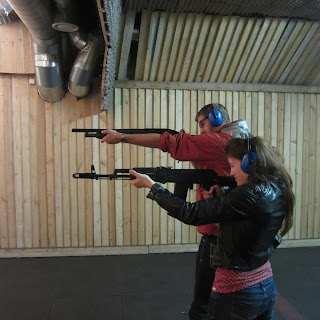
After the shooting range we went back to the city and walked around for a couple hours, seeing Ratslaukums (the town hall square), the museum of occupations (Riga was occupied by the Nazis and then immediately after WWII occupied by the Soviets), and the Freedom Monument before heading home to grab our stuff and catch a taxi to the airport. Here we caught our plane talking us to Brussels, Belgium.


After the shooting range we went back to the city and walked around for a couple hours, seeing Ratslaukums (the town hall square), the museum of occupations (Riga was occupied by the Nazis and then immediately after WWII occupied by the Soviets), and the Freedom Monument before heading home to grab our stuff and catch a taxi to the airport. Here we caught our plane talking us to Brussels, Belgium.


